
Technology is becoming increasingly automated.
Support portals can organize requests. Knowledge bases provide instant answers. AI can help troubleshoot problems. Automated onboarding can make implementations more efficient.
All of these tools have value.
But sometimes a senior living community doesn’t need another automated response.
It needs a conversation.
Senior living dining can be remarkably complex. A community may have an unusual meal plan structure, a unique billing requirement, multiple dining venues, specific resident needs, or a workflow that doesn’t fit neatly into a standard configuration.
The problem may not even be easy to describe in a support ticket.
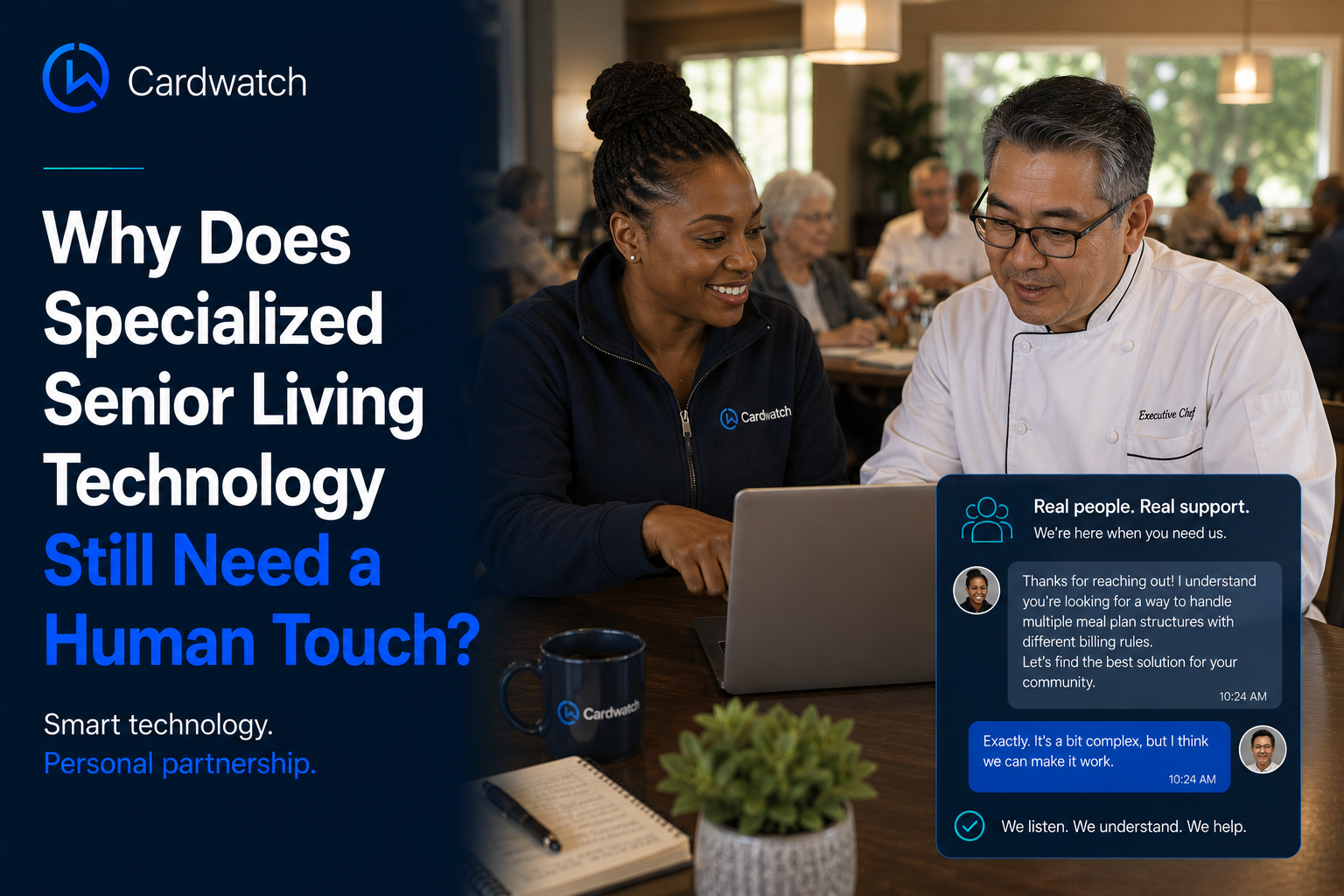
That’s where the human side of technology becomes important.
Someone needs to understand not only what isn’t working, but how the community operates and what they’re ultimately trying to accomplish.
Sometimes the solution is training.
Sometimes it’s a configuration change.
Sometimes the conversation identifies an opportunity to improve the technology itself.
Knowing the difference requires more than processing a request. It requires understanding the customer.
Personal relationships also become increasingly valuable as technology grows more sophisticated.
Communities are adopting connected systems, mobile applications, integrations, artificial intelligence, and increasingly complex dining programs. While these tools can simplify operations, the technology partner behind them still needs to be accessible when questions arise or needs change.
At Cardwatch, being a smaller, independently operated technology company allows us to maintain close relationships with the communities we serve.
Customers aren’t separated from the people who understand the product by endless layers of communication. Our team can listen to an operational challenge, understand the context around it, and help determine the right path forward.
Technology can automate processes.
It can reduce administrative work and make everyday tasks significantly easier.
But great technology relationships still depend on people understanding people.
As technology becomes more sophisticated, the companies building it shouldn’t become less human.
The technology may be digital. The partnership should still feel personal.