
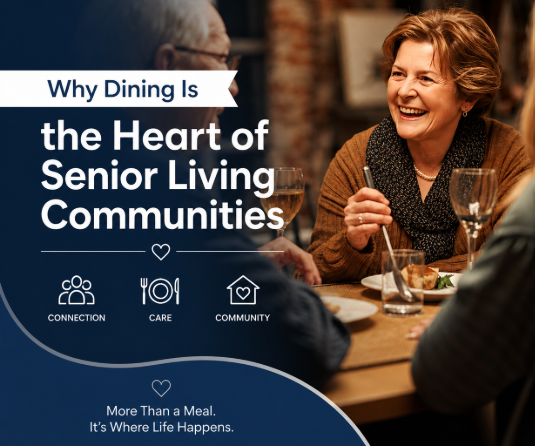
Ask most residents what they look forward to each day and mealtime is usually somewhere near the top of the list. Creating a welcoming senior living dining experience can make these moments even more enjoyable.
And honestly, that tracks. It’s never really just about the food. It’s the table by the window that’s been theirs for two years. The server who brings the coffee before they even ask. The Tuesday that was shaping up to be nothing special until a daughter walked through the door. Little things, but they’re the ones that make a place feel like somewhere you actually belong.
It’s the Anchor of the Day
A lot of residents structure their whole day around mealtimes. It’s where they catch up with the person they’ve been sitting near for three years. Where they hear about someone’s grandkids. Where a quiet morning turns into a genuinely good day.
None of that happens on its own. It takes a dining room that runs well enough to stay out of the way of the experience. The greeting that’s warm because the staff aren’t stressed. The dish that comes out right because someone remembered. The table that’s actually ready, without the shuffle and the apology.
Getting those things consistently right is harder than it sounds.
What Families Pick Up On
Families touring a senior living community are looking at a lot of things at once. The rooms, the care staff, the activities. But the dining room tends to stick with people in a particular way.
A relaxed, attentive dining service tells a family something a brochure can’t really say. That residents are known here. That the details matter. That this isn’t a place just going through the motions.
The opposite sticks just as much. One visit where the service felt rushed, where nobody seemed quite sure what was happening, and that feeling tends to linger. Families bring it up weeks later. Sometimes months.
Where It Gets Complicated
The people running senior living dining rooms genuinely care. That part’s almost never the problem. What makes it hard is just how much is moving at once.
Each resident comes with their own history. Preferences, dietary needs, the way they like things done. And those things shift. A family texts to say they’re coming for dinner in an hour. Something changes with a resident’s diet and the kitchen needs to know before the meal goes out. Two people end up at the same table again because the booking process lives in three different places and nobody caught it.
Any one of those is fine. All of them landing at once, on a busy service, with a team that’s already stretched, is where the experience starts to slip. Not because anyone stopped caring. Just because the systems underneath weren’t built to handle it.
When the Back End Actually Works
The communities that pull off a consistently warm dining experience have usually figured out one thing: the experience at the table depends entirely on what’s happening behind it.
Reservations the whole team can see and trust. Resident preferences that show up automatically instead of someone having to remember or go looking. Families who can book or change a visit without tying up a staff member on the phone. A service where the logistics are handled and the team can actually be present with the people in front of them.
That’s exactly what Cardwatch 4.0 is built for. It brings together reservations, POS, meal plan management, and resident preferences into one connected platform designed specifically for senior living. Not a generic hospitality tool adapted to fit, but something built around how these communities actually work.
Once that’s sorted, the team doesn’t have to think about the logistics anymore. They can just be there, with the people in front of them, doing the part of the job that actually matters.
The Standard Is Worth It
Senior living dining at its best isn’t institutional. It’s personal. It’s built around people who have earned the right to expect things done with care.
That standard is worth holding to. And with the right systems behind it, it’s well within reach.