
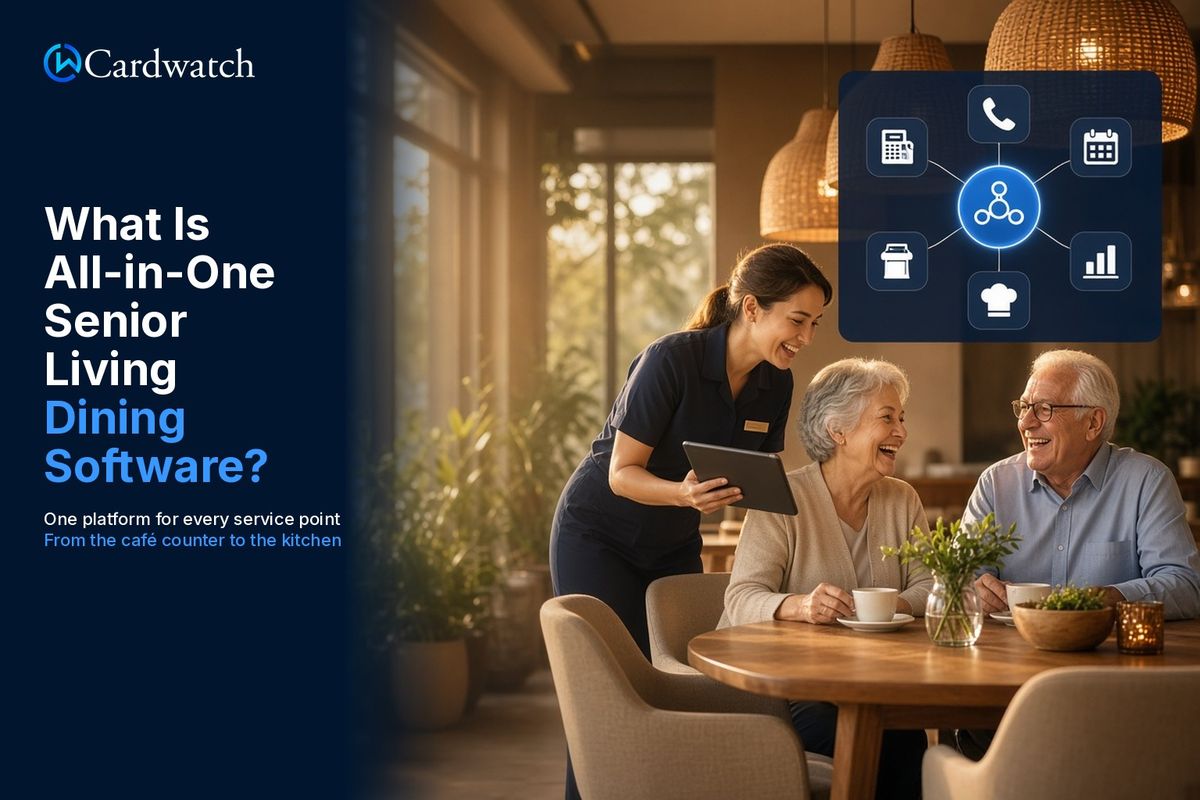
Walk through a typical senior living community at lunchtime and count the systems in use. There's a register in the bistro, a reservation book or spreadsheet at the host stand, a meal plan list in the business office, a separate menu planning tool in the kitchen, and maybe an ordering app that residents were never quite sure how to use. All-in-one senior living dining software is the idea that these moments should run on one connected platform instead of five separate ones.
We've worked with communities that were juggling exactly that kind of patchwork. Each tool did its own job reasonably well. The trouble was everything in between: re-keying charges, reconciling meal plans at month end, and wondering whether the kitchen knew what the dining room had promised. In this post we'll look at what "all-in-one" should actually mean, and how we approach it at Cardwatch.
What Does All-in-One Senior Living Dining Software Include?
"All-in-one" gets used loosely, so it helps to be specific. In senior living, dining isn't one room. It's a café, a main dining room, private dining, assisted living service, events, and residents ordering from their apartments. A true senior living dining platform should cover the full journey, from the resident's account to the moment of service to the culinary work behind it.
At Cardwatch, that journey runs through eight connected applications:
- serveit, a staff-operated POS for cafés, counters and other quick-service locations.
- hostit, full-service dining POS for hosts and servers, with floor plans, tableside orders and checks.
- orderit, mobile ordering and reservations for residents, guests, employees and authorized users.
- skipit, a self-order kiosk where residents and guests browse menus, customize meals and pay.
- swipeit, dining check-in that identifies residents and validates meal-plan eligibility during busy meal periods.
- bookit, dining and event reservations, from party size and table assignment to guest arrival.
- trackit, the back office for resident and guest accounts, meal plans, billing, transactions and reports.
- culinaryai, culinary planning for recipes, menus, nutrition and production, with AI agents where enabled.
You can see how they fit together on our solutions page.
One account behind every service point
The piece that makes it "all-in-one" rather than "eight apps" is the connection underneath. When a resident pays with a meal plan at the café counter, checks in at the dining room with swipeit, or places a scheduled order in orderit, those transactions connect back to the same account in trackit. Meal-plan rules, price levels, discounts and tax are managed in one place, so each service point follows the same rules.
The Hidden Cost of Disconnected Dining Systems
Separate systems rarely fail all at once. They create small, steady friction that's easy to accept as normal.
Double entry and month-end reconciliation
When the POS doesn't talk to the meal plan list, someone has to bring the two together. That usually means exports, spreadsheets and a lot of checking. It's slow, and it's where charges slip through. We've written before about how senior living communities can lose revenue without realizing it, and disconnected tools are often part of that story.
Staff learning too many tools
Every extra system is another login, another screen and another thing to train new staff on. In a field where teams are already stretched, that matters. A connected platform gives staff a more consistent way of working, whether they're at the counter, the host stand or the kitchen.
Residents feeling the gaps
Residents notice when the dining room doesn't know about their reservation, or when they have to explain a dietary need again. When reservations, accessibility notes, special instructions and resident accounts sit together, staff can welcome people with context instead of questions.
Choose What You Need, Keep the Connection
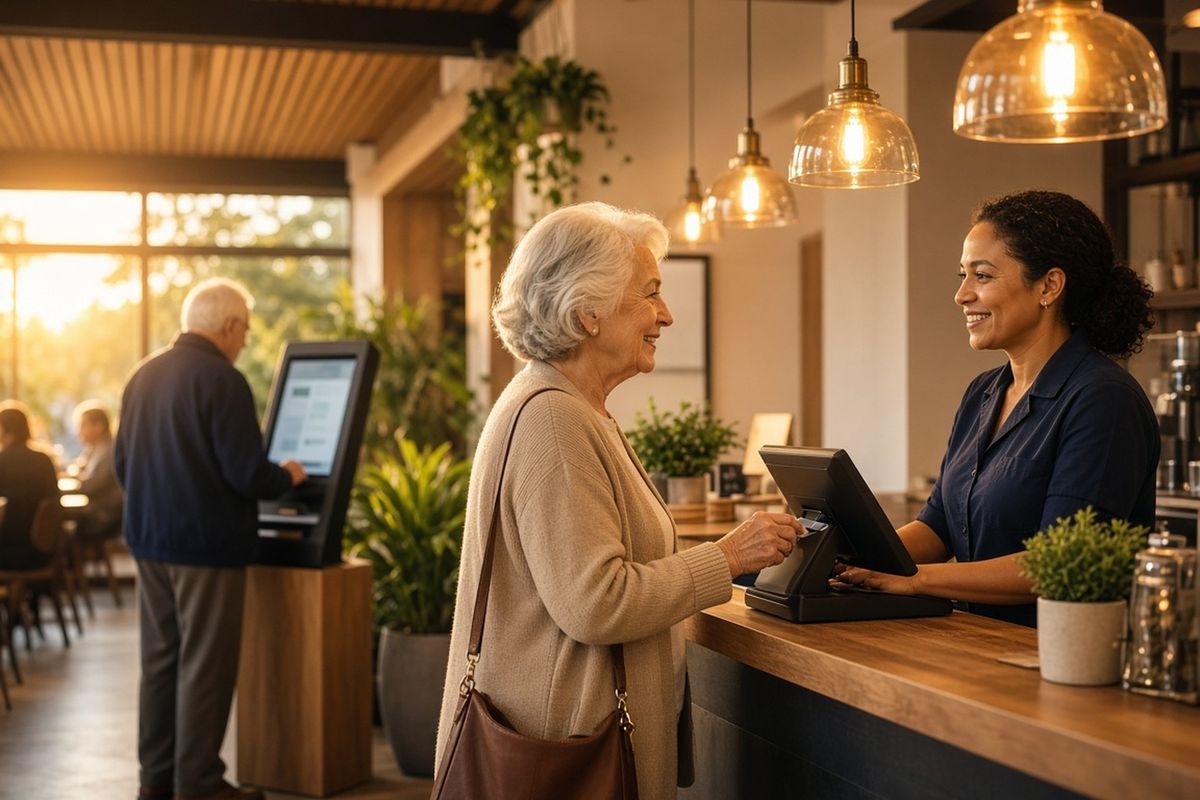
A common worry about all-in-one software is that it forces a community to adopt everything at once. That's not how we think about it. Some teams need a café POS. Others need dining-room service, mobile ordering, a reservation desk, or deeper culinary planning. The idea is to deploy the applications that fit your operation without losing the through-line from resident account to service to culinary operations.
That flexibility matters in senior living, where no two communities run dining the same way. A community might start with serveit and trackit, add bookit and hostit for the main dining room, then bring in culinaryai when the kitchen is ready. Each step adds to the same connected picture rather than another silo.
Connecting the dining room to the kitchen
An all-in-one approach shouldn't stop at the point of sale. In Cardwatch, culinaryai brings recipes, menus, nutrition and production planning into one path, with dietary and allergen information along the way. Where supported POS integrations are in place, transaction activity can inform operational decisions in the kitchen. That's how front-of-house and back-of-house start working from the same information.
What to Ask When You Compare Dining Platforms
If you're evaluating senior living POS and meal plan software, a few questions help separate a truly connected platform from a bundle of separate products:
- Does every service point and payment method connect back to one resident account?
- Are meal-plan rules, pricing and tax set once, or configured in each system?
- Can residents order, book and check their meal-plan details from the same mobile experience?
- Does the kitchen's planning connect to what's happening in the dining room?
- Can you start with the pieces you need now and add others later?
For a wider look at the features that matter this year, see what modern senior living dining software looks like.
FAQ
What is all-in-one senior living dining software?
It's a single connected platform that handles dining POS, ordering, reservations, check-in, meal plans, resident accounts, reporting and culinary planning, so information flows between service points instead of living in separate systems.
Do we have to use every application at once?
No. With Cardwatch, communities choose the applications that fit their operation and keep them connected through shared accounts and reporting. You can add more as your needs change.
How does an all-in-one platform help with meal plans?
When every transaction connects back to the resident's account, meal-plan usage, billing and reports stay in one place. That reduces manual reconciliation and gives administrators a clearer view of what happened at each service point.
Dining is one of the most personal parts of life in a community, and the technology behind it should feel like one experience, not five. If you'd like to see how a connected platform could work for your team, visit Cardwatch and explore the applications.